
Election themes: Pulling out of Paris - a lot to lose and nothing to gain
This is our second article on climate ‘election themes’ that have arisen during the lead-up to the November election. You can read our first article here, where we discuss the fallacy of statements along the lines of ‘New Zealand’s emissions don’t matter’.
Another theme that has re-emerged as the election draws closer is the call for New Zealand to withdraw from the Paris Agreement. To be clear, this proposal is not widely shared among parties: the Prime Minister recently confirmed that staying in the Paris Agreement is a bottom line for the National Party, while opposition parties have dismissed the idea. In this article, we explain what withdrawal would mean for New Zealand.
A quick refresh: What is the Paris Agreement?
There are three ‘primary’ climate change treaties: the United Nations Framework Convention on Climate Change (UNFCCC), the Kyoto Protocol, and the Paris Agreement. They are the principal legal instruments that regulate the international response to climate change, alongside other sources of international law (for example, human rights agreements).
Adopted in December 2015, the Paris Agreement aims to strengthen the global response to climate change, including by “holding the increase in the global average temperature to well below 2°C above pre-industrial levels and pursuing efforts to limit the temperature increase to 1.5°C above pre-industrial levels.” 1.5°C has subsequently been confirmed as the “primary temperature goal” under the Paris Agreement by the International Court of Justice in July 2025.
The Paris Agreement currently has 194 parties, including New Zealand. Under the Paris Agreement, countries must set “nationally determined contributions” (NDCs), emissions-reduction targets that reflect each country's “highest possible ambition” for emissions reductions, along with other criteria. Countries must report regularly on their emissions and implementation efforts, and every five years a ‘global stocktake’ assesses collective progress toward achieving the purpose of the Paris Agreement.
New Zealand currently has two NDCs: NDC1, which ends in 2030, and NDC2 communicated last year, which spans 2031-2035. NDCs are separate from our domestic emissions budgets, which are set under the Climate Change Response Act 2002.
Withdrawal from the Paris Agreement would undermine some of our trade agreements and create considerable reputational risk….
The relationship between New Zealand’s free trade agreements (FTAs) and climate action has been in the news over recent weeks. Withdrawing from the Paris Agreement would expose New Zealand to significant further risk under these agreements. For example:
New Zealand-European Union FTA:
The Paris Agreement is an “essential element” of the NZ–EU FTA. This means that any action by New Zealand that materially defeats the Paris Agreement's object and purpose would allow the European Union to suspend the NZ-EU FTA, in whole or in part. It is hard to imagine a clearer example of defeating the Paris Agreement's object and purpose than New Zealand pulling out.
This is not an abstract risk. At the end of September, Dutch NGO Both ENDS lodged the first complaint on climate and environmental grounds through the European Commission’s Single Entry Point, alleging that New Zealand has weakened environmental protection and failed to implement the Paris Agreement effectively. That complaint focuses on the rollback we have seen in New Zealand over the last few years; a withdrawal from the Paris Agreement would be an action that could not be ignored. The EU is New Zealand’s fourth-largest trading partner, and New Zealand exports to the EU are modelled to increase by up to $1.8 billion a year by 2035. Leaving the Paris Agreement is very likely to have significant consequences for this trade relationship.
UK and India FTAs:
Both FTAs affirm the parties’ commitments to implementing the Paris Agreement. While they are not enforceable in the same way as the EU clause, walking away from the Paris Agreement creates considerable reputational risk with both these trading partners, as well as other countries where trading relationships are being built.
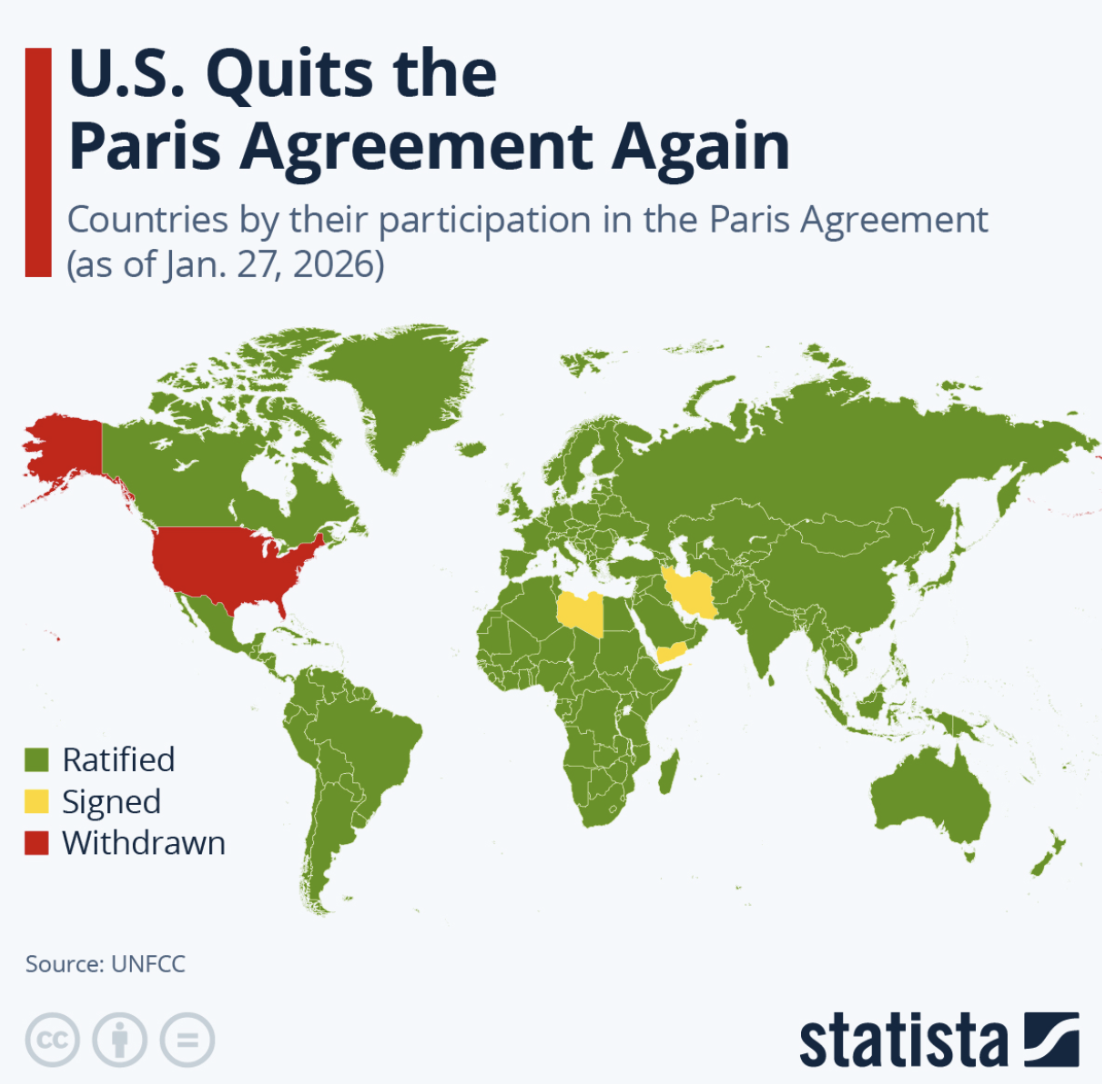
Beyond explicit references to the Paris Agreement in trade agreements, New Zealand would also face broader reputational risks if it left the Paris Agreement. The United States is the only country to have withdrawn from the Paris Agreement so far, joining Iran, Libya, and Yemen as the only United Nations member states not party to the Paris Agreement.
New Zealand prides itself, and indeed trades on, its clean, green reputation. Joining this very limited club of non-participants would likely damage that reputation irreversibly.
Image Source: Anna Fleck | Statista.
…And leaving would not give us immunity from international law obligations
Withdrawal from the Paris Agreement is often presented as a way to remove all obligations to reduce greenhouse gas emissions, but that is not the case.
Last year, the International Court of Justice (ICJ) clarified in its landmark advisory opinion on Obligations of States in respect of Climate Change (Advisory Opinion) that all countries are under an obligation to prevent significant harm to the climate system and other parts of the environment under customary international law, whether or not they are a party to the Paris Agreement:
“With regard to obligations under customary international law, the Court observes that the most significant primary obligation for States in relation to climate change is the obligation to prevent significant harm to the climate system and other parts of the environment […], which applies to all States, including those that are not parties to one or more of the climate change treaties…”
Obligations of States in respect of Climate Change (Request for Advisory Opinion) at [409] International Court of Justice (July 2025)
The ICJ held that this duty requires a “stringent” standard of due diligence, and a country that fails this standard may commit an internationally wrongful act. Notably, the ICJ identified fossil fuel production, fossil fuel subsidies, and granting fossil fuel exploration licences as conduct that may breach the duty to take appropriate action to protect the climate system from GHG emissions. Further, as the ICJ explained, “the protection of the environment is a precondition for the enjoyment of human rights” (at [373]). New Zealand would therefore still have obligations under various human rights treaties.
In short, pulling out of the Paris Agreement would not only put New Zealand’s trading relationships at risk, but would do so without removing the legal imperative to reduce emissions.
…Nor would it have any obvious benefit for New Zealand
It is important to note that taking effective action to reduce our emissions here in New Zealand is not a trade-off between business or farming interests and the climate. Reducing the scale of climate change is a precondition for these interests to continue, as the last few months in Europe have shown. Recent analysis from the Energy and Climate Intelligence Unit (ECIU) estimates that record-breaking European heat and drought over the summer is likely to cost European farmers about €3.2B (~$6.34B NZD) in lost grain production. As ECIU explains, that is “equivalent to the entire grain output of Italy, Belgium and the Netherlands combined”. Further, as the recent UNEP Limiting Overshoot Report explains, climate change will drive significant productivity losses and threaten the food security and livelihoods of billions of people. Reducing emissions may require traditional business practices to shift, but effective climate action doesn't have to be ‘anti-farming’ or ‘anti-business’.
The Paris Agreement is the floor, not the ceiling
This article only covers the tip of the iceberg in terms of reasons for New Zealand to stay in the Paris Agreement - from the clear scientific consensus that we must reduce emissions, to the ability for New Zealand to take advantage of being an ‘early mover’ and leader in creating a thriving low-emissions economy (you can also read our recent article where we deconstruct the common argument that New Zealand’s emissions do not matter on a global scale: they do).
It's disappointing to see that, 11 years on from Paris, we have regressed to a place where our bottom line is staying in the agreement, rather than effective implementation. Staying in the Paris Agreement is the floor, not the ceiling, for what New Zealand should be doing. New Zealand should use this opportunity to move past this floor, set out a plan to meet our international obligations, and restore our international reputation as a climate leader.