
The law is a powerful tool for climate action. It can hold decision-makers to their obligations, protect communities from harmful projects and help people recover after climate harm. But it is also expensive and hard to access - and climate change is creating new legal challenges.
Research is starting to show what this looks like in practice. A recent study examined the association between climate change (both disasters and indirect, slow-onset impacts), civil law problems, and access to justice in Australia’s legal assistance sector. QUT’s Monica Taylor found that lawyers overwhelmingly believed climate change is increasing both the number and the complexity of civil legal problems their clients face.* Those problems range from tenancy and insurance disputes after disasters to slower harms, such as homes becoming less habitable, with legal processes unfit for purpose in a changing climate. The same lawyers did not think their sector was equipped to meet the growing demand.
These findings echo experiences reported in Aotearoa New Zealand. For example, this article by the New Zealand Law Society details the aftermath of Cyclone Gabrielle: Community Law offices in Gisborne and Wairoa were closed for around two weeks, and when they reopened, the centre produced communications in response to queries about landlords continuing to charge rent and demanding payments from tenants. Further, a 2023 report by the Child Rights International Network on children’s access to justice for environmental rights found that in Aotearoa New Zealand “there are serious access to justice issues in terms of legal aid or pro bono in the environmental context, as legal aid is available generally for family or criminal matters”.
Access to justice is also about having a say. Communities and individuals trying to take part in decisions on projects that will lock in emissions or affect their environment face increasing barriers - from losing submission rights to compressed timeframes, alongside the cost of any legal support.
Pro bono support
Pro bono work is one way in which affected groups can access legal support in relation to environmental or climate issues.
Lawyers for Climate Action can help to facilitate this through our pro bono matching network.
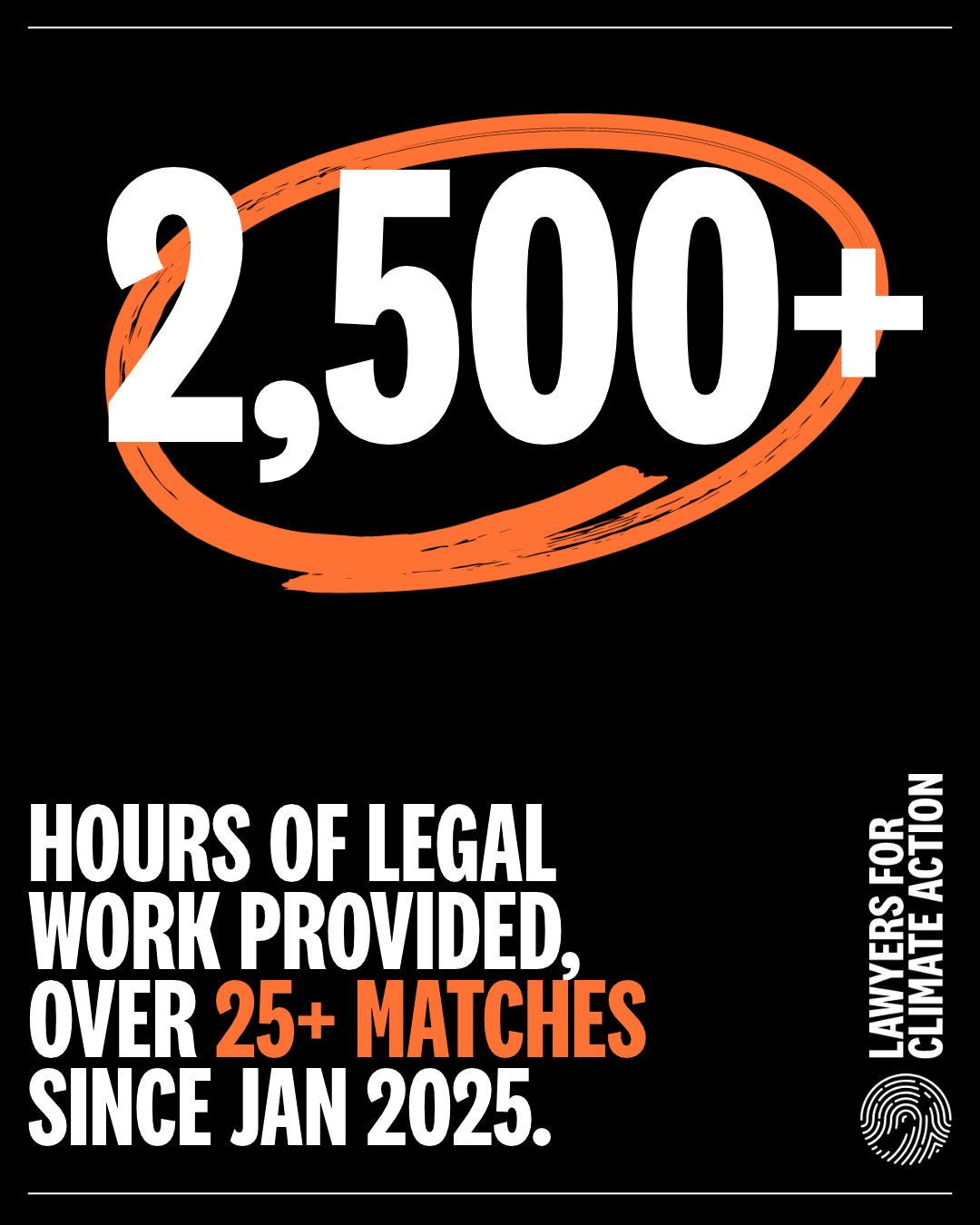
Since January 2025 we have made 25+ matches, connecting community groups, individuals and NGOs facing climate-related legal issues with legal support pro bono or at a reduced fee over a range of different areas: from Fast-Track Approvals Act 2024 processes to support navigating charity rules, to local government issues.
This service would not be possible without the extraordinarily generous time and energy donated by lawyers from around the country who care about access to justice for climate issues.
Other services that can help groups or individuals to access pro bono legal advice for environmental or climate issues include Community Law and Te Ara Ture.
Better guardrails in the first place
While services like our pro bono matching service can help increase access to justice, they also treat the symptoms rather than the root of the issue. Lasting access to justice, and reducing the need for expensive and resource-intensive litigation requires addressing the system itself.
This includes, at a minimum, facilitating meaningful public participation in the law-making process, and ensuring access to appeal rights. Unfortunately, our current system seems to be heading in the wrong direction. For example, the increasing use of urgency to pass laws (such as the 10 days provided to submit on the Climate Change Response (Tort Liability) Amendment Act) raises concerns about the ability of the public to provide input on far-reaching environmental and climate laws; and the reduction of appeal rights (like in the Fast-Track Act) is significantly curtailing the ability to be heard.
Access to justice is a right, and one that must be upheld within the context of climate change.
If you think you may need support, you can find out more on our Pro Bono Assistance page, including the scope and eligibility. Please note that Lawyers for Climate Action is not a law firm and does not provide legal advice; our role is to connect you with a lawyer who can. We will do our best to find a match, but we cannot guarantee one. Demand often exceeds the capacity of our volunteer network. If we can't help, we may refer you to other organisations where appropriate (for example, Community Law and Te Ara Ture) .
If you are a lawyer interested in becoming a part of the pro bono matching network, you can find out more here.
For any questions, contact us through probono@lawyersforclimateaction.nz
*Monica Taylor, ‘How Does Climate Change Affect Access to Justice? Perspectives from Australian Lawyers on the Frontline’ (2026) 48 Sydney Law Review 20986:1–26 <https://doi.org/10.30722/slr.20986>.