
Election themes: ‘New Zealand’s emissions don’t matter’
‘New Zealand’s emissions are too small - it doesn’t matter what we do’ - it's a claim that seems to pop up everywhere, and often around elections. Of course, the subtext of this claim is that New Zealand’s emissions are so small we do not have any responsibility to reduce them. This ‘drop in the ocean’ argument has become increasingly prominent in the lead-up to the 2026 general election. In this article, we explain why it fails both legally and logically, and why it cannot be reconciled with the collective, urgent action climate change demands.
Climate change is a collective problem, and the countries that make up less than 1% of global emissions all add up
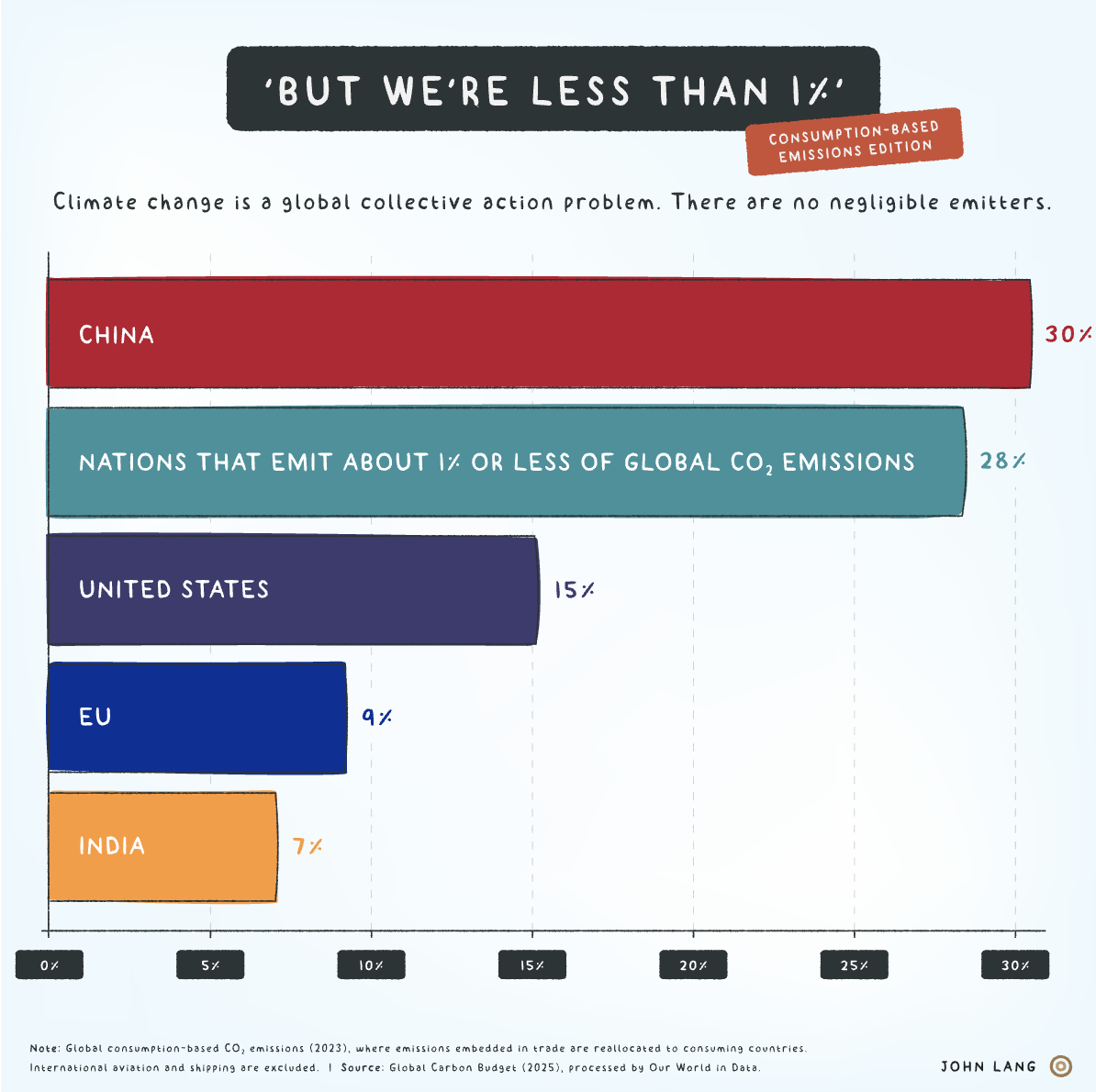
In 2025, countries contributing less than 1% of global emissions collectively accounted for about a quarter of global emissions. That is, if we let our ‘small share’ of emissions be a reason not to reduce, that same logic applies to 25% of global emissions (MCERT & Stats NZ “Our Atmosphere & Climate Report 2026”).
Climate change is a global problem; in many ways, where you live doesn't matter. A tonne of greenhouse gases emitted in Tauranga warms the planet as much as a tonne emitted in London.
If we ringfence the emissions of a population of five million from this global total and say, “this is too small to count”, there is no reason every other population of five million cannot do the same. We would not say that residents of Greater Sydney (approximately five million people), or all left-handed people in Spain (also approximately five million people) do not need to reduce their emissions because they are so small. The same logic applies to small country populations.
Image Source: climatetrunk.com | John Lang
Climate change is a collective issue: no one country is absolved of responsibility simply because it believes its contribution is too small. This ‘collective action’ problem is the reason why we have the Paris Agreement. Unless everyone acts, most significantly the US, China, the EU, India, and other big emitters, but also all the 1%s, including New Zealand, we cannot address climate change.
New Zealand is responsible for more than its fair share of climate emissions
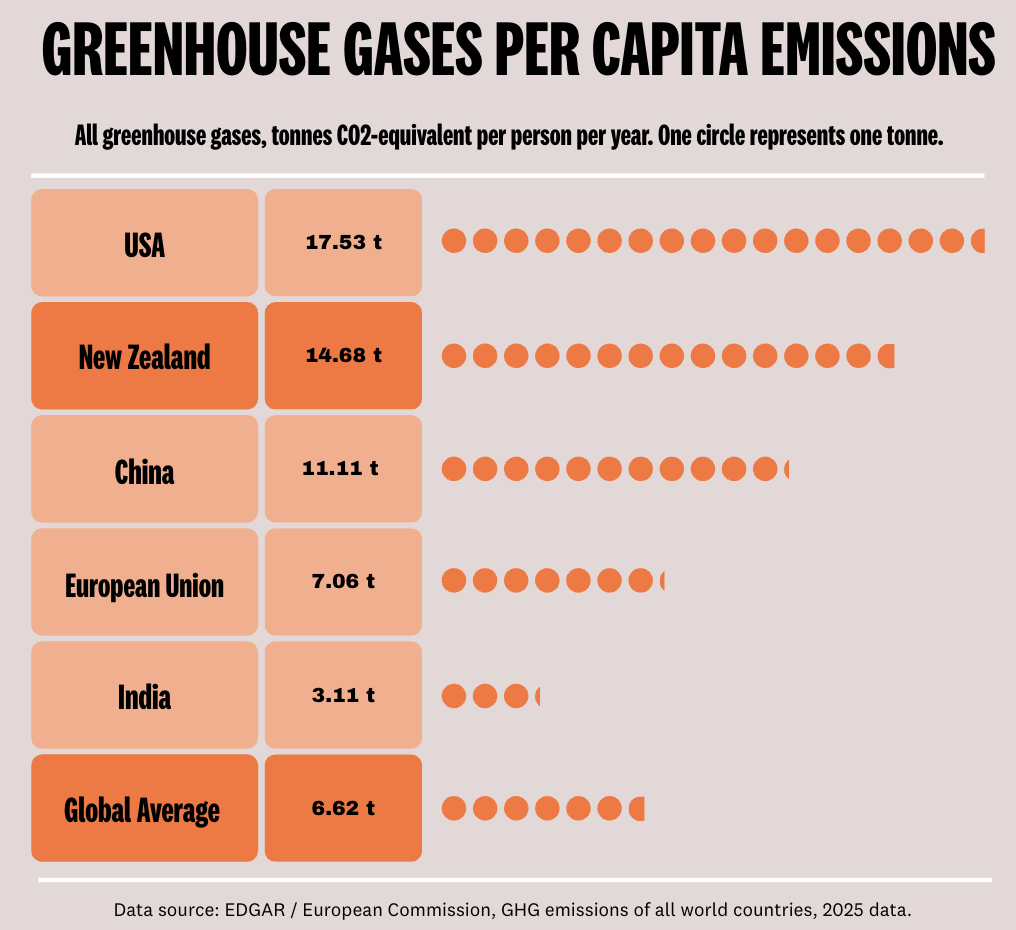
In addition, despite our small population, we contribute much more than our fair share to climate change.
As the recently released “Our Atmosphere & Climate Report 2026” explains, New Zealand makes up 0.06% of the world’s population, but our emissions account for 0.17% of all global emissions - New Zealand’s GHG emissions per capita are just under the United States, and significantly more than China, the European Union, and India (EDGAR, 2026).
Data source for image: EDGAR.
As the “Our Atmosphere and Climate Report 2026” further explains, if global per person emissions were maintained at levels similar to New Zealand’s, “warming would be projected to peak at 5 degrees Celsius and decline to approximately 4.3 degrees by the year 2100”. As context, even 1.5°C of warming is not considered safe, and every fraction of a degree beyond it increases exposure to climate hazards and the risk of irreversible loss. Peak warming of 5°C would be catastrophic.
New Zealand’s emissions profile does not exempt us from action
New Zealand has a high proportion of methane in its greenhouse gas profile; the latest Greenhouse Gas Inventory found that in 2024 methane accounted for 48 per cent of New Zealand’s gross emissions. Methane is a “short-lived GHG”, meaning it does not last as long in the atmosphere as other GHGs such as carbon dioxide. However, while it remains in the atmosphere for less time, it has a much higher warming effect during that period than other long-lived pollutants. As the recent UNEP Overshoot Report found, methane and other short-lived climate pollutants need urgent reductions alongside long-lived GHGs, and methane plays a particularly important role in this.
Courts around the world have rejected this argument
‘Drop in the ocean’ arguments are one of the most common defences run by governments and corporations across the world in climate litigation. However, courts across jurisdictions have repeatedly rejected this line of argument, from the Netherlands to the United States - to the world’s highest court: the International Court of Justice. Specifically, the International Court of Justice (ICJ) found in its recent advisory opinion on climate change that:
First, “while climate change is caused by cumulative GHG emissions, it is scientifically possible to determine each State’s total contribution to global emissions, taking into account both historical and current emissions” (para. 429) and
Secondly, “the rules on State responsibility are capable of addressing situations where damage is caused by multiple States engaging in wrongful conduct, and that the responsibility of a single State for damage may be invoked without invoking the responsibility of all States that may be responsible” (para. 430).
As Joe Udell of the Climate Litigation Network explains, the ICJ has effectively dismissed one of the main arguments governments advance and will undoubtedly strengthen plaintiffs' ability to hold them accountable for climate inaction.
Those who have contributed the least have the heaviest burden
While climate impacts are already being felt here, we need to be clear about who bears the heaviest burden. The IPCC has found that vulnerable communities who have historically contributed the least to climate change are disproportionately affected (high confidence), and that small island states in the South Pacific are being displaced by climate extremes at rates disproportionate to their small populations. Among those on the frontlines are Tokelauans, Cook Islanders, and Niueans, who are New Zealand citizens - as well as the friends and family of many New Zealand citizens. Our neighbours cannot afford for us to keep hiding behind ‘drop in the ocean’ arguments.
Finally, as Marc Daalder recently put it:
“New Zealanders made up around 0.2 percent of Allied forces in each of the World Wars, but we do not say their efforts and sacrifice were in vain”
By Laura MacKay & Molly McDouall.